
Around meta-analysis (16): meta-data, metadata, and more meta confusion
Part of COSSEE’s ongoing meta-analysis series, this post focuses on terminology and conceptual clarity.
This post is inspired by Coralie’s recent blog post, “ Meta-analysis terminology can be confusing ” , in which she untangles a range of commonly used, misused, and confused terms in meta-analysis—such as subgroup analysis , moderator analysis , meta-regression , fixed-effect vs fixed-effects models , and multivariate .
These certainly warrant clarification. But what about the terminology for the underlying data —could that be just as confusing?
What is “meta-data”?
There are many definitions of meta-data (or metadata ), but most describe it as “the information that defines and describes data” ( ABS ). Since information is also a form of data , meta-data itself can have meta-data … which can have more meta-data … and so on. Conversely, a dataset can include meta-data , which itself may include even deeper layers of meta-data . This creates a kind of conceptual circularity that adds to the confusion—especially in the context of meta-analysis (and systematic reviews of all sorts).
Does meta-analysis use meta-data?
Yes—but not always in the way people expect.
It is common to assume that meta-data simply refers to the dataset compiled and analyzed in a meta-analysis, especially since both terms contain the prefix “meta” and deal with data from primary studies. As a result, when researchers are asked to share both their data and meta-data , they often upload only the dataset itself. However, in this context, meta-data refers specifically to the description of the dataset: a detailed explanation of the variables, their definitions, units, data structure, etc. But this may also contain some information that can be considered meta-data , contributing to the confusion.
Visualising layers of meta-data in meta-analyses
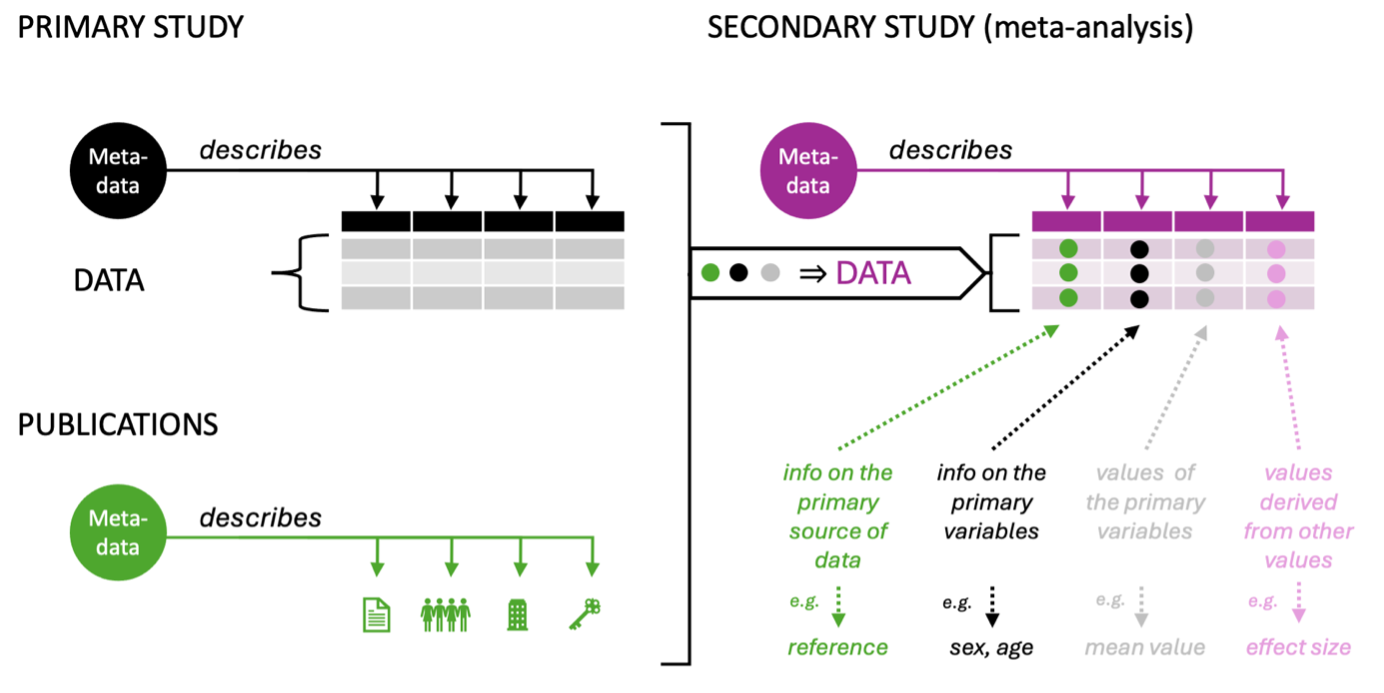
What counts as “ data ” or “ meta-data ” depends on the context (see my diagram above). In a primary empirical study, the data might consist of field or lab measurements of things, humans, or systems, while the meta-data includes descriptions of the variables in that spreadsheet ( black parts of the diagram above) .
But once a primary study is published (or shared), it gains another layer of meta-data : title, abstract, publication date, author names, affiliations, etc. This is the meta-data librarians and other information specialists work with ( green parts of the diagram above).
In a secondary study, such as a meta-analysis or systematic review, you typically compile not only data of primary studies (selected results and their descriptors), but also some of their meta-data (e.g., study-level characteristics such as study reference, title, authors, journal, DOI, etc.), and then also generate new data for your synthesis (e.g., recalculated effect sizes). The resulting dataset is a layered mix of data and meta-data from different sources and levels.
What to do in practice
In practice, for a meta-analysis (and systematic reviews or other secondary studies) use terminology consistently in the context of your study: call your dataset “data”, and description of your dataset “meta-data” ( purple/plum, NOT pink, parts of the diagram above) . You can still acknowledge that your data contains some meta-data from underlying primary studies (e.g. information describing the publications).
Why it matters
Conceptual complexity—and the commonly inconsistent use of terminology—may partially explain why appropriate meta-data is often missing or poorly documented in shared datasets from meta-analyses (and various types of systematic reviews). When people are asked to share meta-data – but they think this is just their dataset ( data ) – they only share the dataset, without description of all variables ( meta-data ). But without complete and well-structured meta-data (the descriptions of data ), it becomes difficult to interpret the dataset (the data ), let alone reuse it or reproduce the analyses. Transparent and clear meta-data (descriptions of data = dataset) is crucial for making meta-analyses truly open and reusable.
NOTE:
You can find earlier blog posts from my “ Around meta-analysis ” series archived on my personal website .