
The Elephant in the Graduate School Room: Why does the relationship with your advisor fail? (And how to fix it)
A COSSEE blog post on advisor-student expectations, formalising supervision, and reducing friction in graduate training.
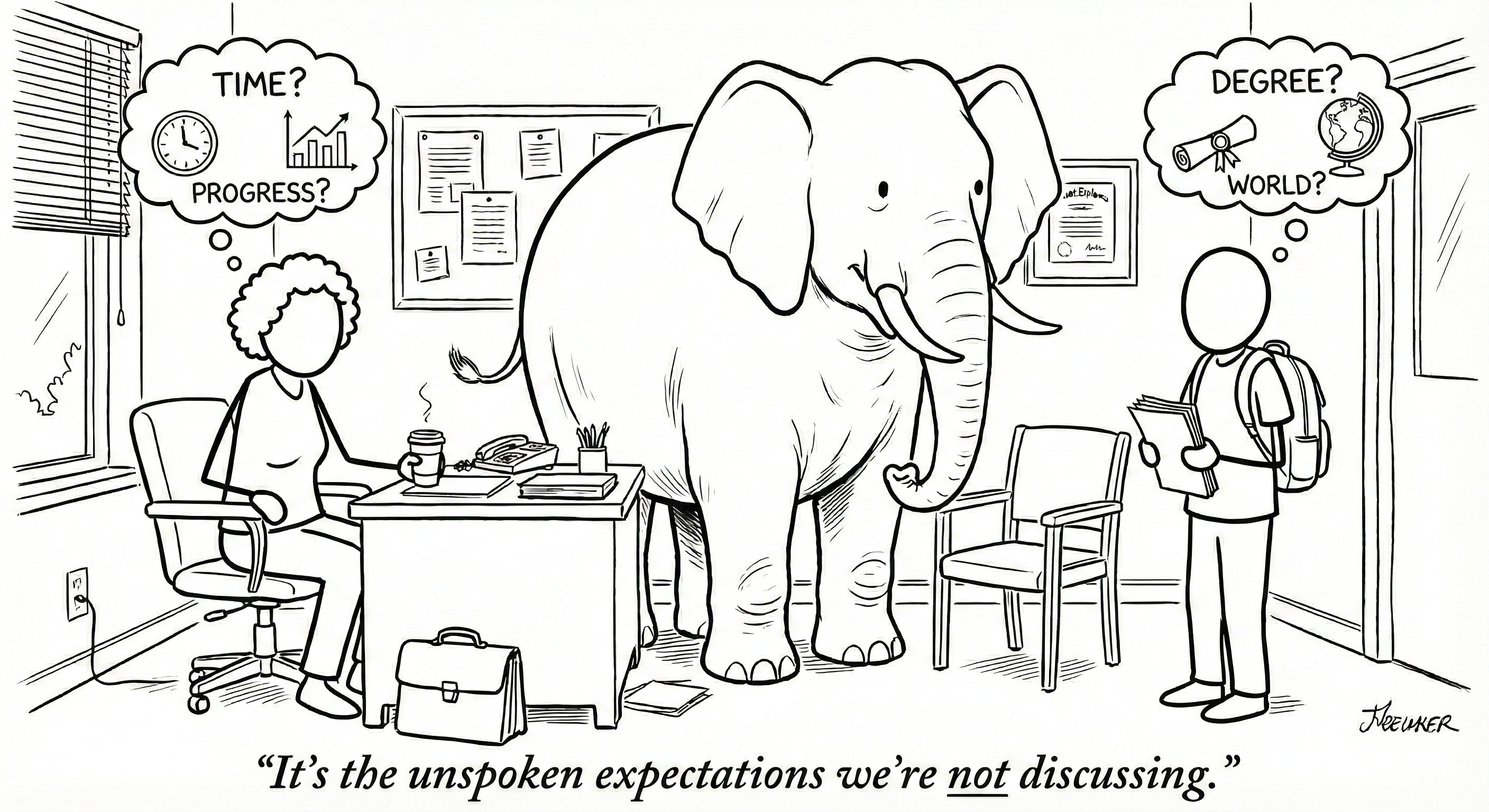
If you talk to ten graduate students, most will say that the biggest challenge is not complex
statistics or the volume of reading, but rather the relationship with the person advising their
work. Between the lines of academic articles, the “advisor” figure frequently appears as one of
the greatest barriers to success and mental health. In fact, recent studies indicate that “lack of
time” and “academic advisor” are the most frequently reported barriers in self-reports by
Brazilian students (Pinzón et al., 2020).
Why does this relationship, which should be one of partnership and construction, generate so
much frustration? A very common mistake is that most advisors start advising without defining
clear rules. Graduate programs usually provide bureaucratic guidelines on enrollment and
norms for structuring dissertations and theses, but they fail to explain conduct, duties, and how
advising should occur on a day-to-day basis. As a result, without prior formal preparation, many
advisors act intuitively, guided by trial and error or past experiences. Without clarity of roles,
students do not know what to expect, and advisors do not know the limits of their actions,
weakening both the quality of the research and the relationship itself.
But how do we solve this in practice? The solution is not just to “talk more,” but to formalize
what is left unsaid.
The Problem: The Expectations Vacuum
Most problems arise because each side—students and advisors—assumes that the other
knows what to do. On one side, advisors expect autonomy. On the other hand, students expect
direction. This lack of harmony is not just a detail, as academic dialogue is influenced by
affective, professional, and institutional aspects that shape all scientific production (Viana,
2008). When these expectations do not match, the result is frustration and a direct impact on
well-being, with moderate levels of depression and anxiety reported in the academic
environment (Pinzón et al., 2020).
The Solution: The “Supervisor-Student Agreement”
To generate real value in your research routine and mitigate this mismatch, I suggest using a
practical tool: an expectations agreement . It is not a legal contract, but an alignment of
conduct and a “record of intentions”.
Here are the main points this agreement should cover for your research to flow:
- Meeting Cadence: Do not leave it at “we’ll keep in touch”. Define the frequency and
who is responsible for the agenda. Modern advising requires the supervisor to ensure
specific training and bridge the gap between research and teaching (Nóbrega, 2018).
- Writing Feedback: How much time does the supervisor need to read a chapter or a
manuscript you are writing?. Defining this prevents the student’s research from stalling.
A student’s self-efficacy and academic literacy depend directly on this articulated support
(Magalhães, 2024).
- Data Ownership and Authorship: Who owns the data after graduation?. How will the
order of authorship be decided?. Discussing this early avoids ethical conflicts and
headaches later on.
- Autonomy vs. Supervision: Does the student need a step-by-step guide or do they
prefer freedom?. Aligning management styles prevents feelings of abandonment or
micromanagement (Lopes et al., 2020).
Why Does This Change the Game?
When you put these expectations on paper, you remove the emotional weight of demands. The
relationship between supervisor and student is the foundation of the scientific production
process (Lopes et al., 2020). Professionalizing it through an expectations agreement can help
separate success from burnout .
Golden Tip: Supervisors, offer this model to the students in your lab. If you are a
student, take the initiative and schedule a meeting with your advisor to discuss this
agreement. This demonstrates maturity and commitment to the work.
Graduate school is challenging enough. Having a map of how you and your mentor will
work together is a good first step toward making the advising process profitable. Don’t
forget that you can—and should—revisit and discuss these expectations as often as
necessary. Over a long PhD process, many understandings may change as needs and
maturity levels evolve.
The idea of discussing this agreement came from my own experience in my PhD. I had the
chance to use an expectations model with my supervisor, and while our relationship was already
very good, having that document certainly helped organize our interactions over nearly four
years of research.
I will attach a file (see below) to this post with the expectations agreement model I edited based on what I
used. While this model generally works for graduate students, it can be edited to mediate
relationships with post-docs, supervisors, or even lab staff.
I’m also including some references to studies investigating the advisor-advisee relationship. I
hope this helps! If you need anything, feel free to message me.
Expectations agreement model.
References
- Lopes, E. F. B. et al. (2020). A relação entre orientador e orientando no processo de
produção científica. Brazilian Journal of Development.
- Magalhães, L. (2024). Você já leu o meu trabalho? Interrogando expectativas e realidades
na relação entre discentes e docentes, na pós-graduação brasileira. Movimento.
- Nóbrega, M. H. (2018). Orientandos e Orientadores no Século XXI: desafios da
pós-graduação. Educação & Realidade.
- Pinzón, J. H. et al. (2020). Barreiras à Carreira e Saúde Mental de Estudantes de
Pós-graduação. Artigo jul.-dez. 2020.
- Viana, C. M. Q. Q. (2008). A relação orientador-orientando na pós-graduação stricto sensu.
Linhas Críticas.